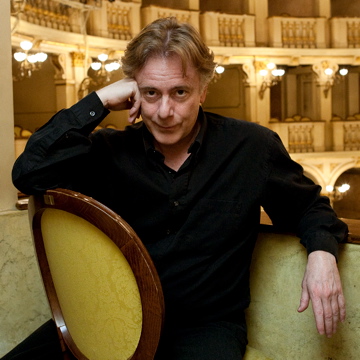
Marco Tutino
COMPOSER
"If you want to hear what a Puccini of the 21st century might have sounded like, this is as good a starting point as any."
Marco Tutino was born in Milan in 1954. In parallel with his classical studies, he obtained two degrees at the Conservatory of his native city, in Flute and in Composition.
He made his debut as a composer in 1976, taking part in the Gaudeamus Festival in the Netherlands. Since then, his music has been programmed and performed—with great success among both audiences and critics—around the world by prestigious concert and symphonic institutions and in major opera houses.
Over the years Tutino’s activity has developed primarily in the field of musical theatre. After his first opera, Pinocchio (1985, commissioned by I.C.O.S.S. in Vienna and the Opera of Genoa), came Cirano (1987, Laboratorio Lirico di Alessandria, directed by Gabriele Salvatores; revived in 1990 by the Arena di Verona), La Lupa (1990, Mascagni Centenary in Livorno), the concert drama Vite immaginarie (1990, Teatro Comunale di Bologna), Federico II (1992, commissioned by the Bonn Opera), Il gatto con gli stivali (1994), Dylan Dog (1999) and Peter Uncino (2001), commissioned by the Fondazione Arena di Verona; Vita (2003, commissioned by Teatro alla Scala); Le Bel indifférent (2004, commissioned by the Macerata Opera Festival); La bella e la bestia (2005, commissioned by the Teatro Comunale di Modena); The Servant (2008, Macerata Opera Festival); and Senso (2010, commissioned by Teatro Massimo in Palermo, where it opened the 2011 season).
He later composed Le Braci (commissioned by Teatro dell’Opera di Firenze and the Festival della Valle d’Itria, 2013), La Ciociara (commissioned by San Francisco Opera, 2015), Miseria e Nobiltà (commissioned by Teatro Carlo Felice in Genoa, 2017), and Falscher Verrat (commissioned by the Kiel Opera, 2018).
Tutino was the creator, promoter and—together with six other composers he selected—co-author of the Requiem per le vittime della mafia, performed in Palermo Cathedral on 27 March 1993.
La Lupa was revived by the Szeged Opera (Hungary) in 1994 and 1995, becoming the greatest operatic success of that theatre in the previous decade. The recording of the 1990 version received the Italian Presidenza della Repubblica Award.
Teatro alla Scala commissioned and performed his Concerto for Clarinet and Orchestra in its 1994 symphonic season; the work was later taken up by the BBC Symphony Orchestra in London in January 1996.
For the Teatro Sociale in Rovigo and the Teatro Comunale in Treviso, Tutino composed—on choreography by Gheorghe Iancu—the ballet Riccardo III, premiered in October 1995 and later revived in the 1996/97 season of Teatro La Fenice in Venice.
In spring 1997, the Arena di Verona presented a portrait of Marco Tutino, programming two works it had commissioned: Il gatto con gli stivali and Pugacev. In the 1999/2000 season of the Opera of Metz (France), Il gatto con gli stivali was revived in a co-production with other European theatres.
In March 1998, Teatro Massimo in Palermo produced a new staging of La Lupa, starring Marjana Pentcheva.
In 1999, the lyric ballet Dylan Dog premiered as part of the “Futuri” project, conceived by Tutino for the Fondazione Arena di Verona.
The year 2000 opened with new international productions of Il gatto con gli stivali (France and Germany); the Kyrie and Agnus Dei commissioned by the Sagra Musicale Umbra for the Jubilee and performed on the Capitoline Hill in Rome; the musical Peter Pan commissioned by the Piccolo Teatro di Milano; and a new staging of Vite immaginarie at the Teatro Vittorio Emanuele in Messina.
In 2001 the Teatro Filarmonico in Verona produced Peter Uncino, with Milva, David Riondino and a libretto by Michele Serra. The production toured thirty major Italian theatres.
In March 2002, the Opera of Metz presented a new staging of Cirano for its 250th anniversary. La Lupa had its German premiere in Erfurt in September 2002, followed in March 2003 by a new production of Il gatto con gli stivali, later included in the 2003/2004 season of the Rome Opera.
On 28 April 2003, at the Teatro delle Muse in Ancona, Tutino’s Canto di pace for tenor, chorus and orchestra—on a text by John Paul II and sung by Plácido Domingo—was performed and broadcast internationally. The work was later sung by Roberto Alagna (2003) and Andrea Bocelli with the Maggio Musicale Fiorentino (2006).
Teatro alla Scala premiered Vita in May 2003, starring Anna Caterina Antonacci and Michele Pertusi.
La Lupa continued its notable success with new productions in 2006 (Teatro Sociale in Rovigo) and 2008 (Teatro Comunale in Bologna, starring Roberto Alagna).
Federico II had its Italian premiere in Jesi in October 2004, receiving great success among audiences and critics.
Following Le Bel indifférent—a triumph at the Macerata Festival and later performed at Teatro Stabile di Torino and Teatro Lirico di Cagliari—Tutino presented La bella e la bestia (2005), directed by Damiano Michieletto.
The Macerata Opera Festival commissioned a new opera from Tutino, based on Robin Maugham’s The Servant. Premiered in 2008 and directed by Gabriele Lavia, it received unanimous acclaim.
In 2008, the Opera of Ostrava (Czech Republic) added La Lupa to its repertoire, followed by Vita in 2009 and a Szeged production.
In 2010 The Servant was produced in Plzeň and revived in Szeged. Tutino’s music has by now entered the contemporary operatic repertoire.
In 2011, Teatro Massimo in Palermo opened its season with Senso, commissioned to mark the 150th anniversary of Italian unification, to great public and critical success.
San Francisco Opera commissioned La Ciociara for the 2014/15 season—the first time since Puccini that an American theatre commissioned an Italian composer. The work received an exceptional reception, hailed by General Director David Gockley as an unprecedented event for the company.
Maestro Tutino’s chamber opera Le Braci premiered in full form at the Festival della Valle d’Itria and the Maggio Musicale Fiorentino in 2015, after a preliminary performance in Budapest.
Among his recent successes: the European premiere of La Ciociara in Cagliari (2017), the world premiere of Miseria e Nobiltà in Genoa (2018), and Falscher Verrat in Kiel (2018).
In 2022, Teatro Regio Torino, Piccolo Teatro di Milano, Teatro Massimo Palermo and MITO commissioned a music-theatre work from Tutino, premiered to strong public and critical acclaim.
His most recent symphonic work, In amoroso furore, was premiered in November 2022 at Teatro Lirico di Cagliari.
In October 2023, La Ciociara was presented at the Wexford Festival Opera, staged by Rosetta Cucchi and conducted by Francesco Cilluffo, receiving enormous success and being voted “Opera of the Year” by OperaWire.
In 2024, the Teatro Bellini in Catania presents La Lupa and a new work, Il berretto a sonagli, directed by Davide Livermore. The Teatro Lirico di Sassari stages Falso tradimento, the Italian version of Falscher Verrat, in its Italian premiere, directed by Ugo De Hana.
In 2017 Tutino published Il mestiere dell’aria che vibra (Ponte alle Grazie), a combined memoir and handbook for those approaching the world of opera.
Parallel to his composing career, since 1990 Tutino has held major artistic and managerial roles in Italian opera houses: consultant at Teatro Valli in Reggio Emilia; Artistic Director of I Pomeriggi Musicali in Milan; Artistic Consultant and Composer-in-Residence at the Arena di Verona; Artistic Director of Teatro Regio in Turin; and Superintendent and Artistic Director of the Teatro Comunale in Bologna, where he led a major financial restructuring.
In 2008 he founded the Scuola dell’Opera Italiana in Bologna, an academy dedicated to preserving and transmitting the Italian operatic style.
He served as President of ANFOLS (2009–2011) and as a member of the Italian Ministry of Culture’s Music Committee (2011–2013).
Marco Tutino is a member of prestigious scholarly committees and the recipient of numerous awards. His name appears in authoritative encyclopedic publications on the history of music and opera.